Key takeaways
- Unichem is acquiring Loomia for roughly 8.6 bn won (≈ $6 M) and plans to integrate Loomia’s ultra‑thin LEL layer into its product line.
- The Loomia Smart Skin developer kit combines capacitive and force‑sensitive‑resistor (FSR) sensors on a flexible mesh that can be adhered to cloth or leather.
- R&Y intends to ship an engineering sample that measures both normal pressure and shear force in January 2027, using Loomia’s LEL platform.
- A European research team has shown a mechano‑chromic fingertip that can produce pressure maps at 100 µm resolution by detecting colour changes.
- Together, these advances give robot‑hand designers tools to sense force vectors and fine surface textures in real time.
Unichem‑Loomia merger: tactile hardware meets leather heritage
Unichem announced that it will acquire 100 % of Loomia Technologies. The transaction will be settled through cash, equity and performance‑based earn‑out components and is expected to close on Oct. 15 via a reverse triangular merger with a newly formed Unichem subsidiary. By merging Loomia’s low‑resistance LEL (Loomia Electronic Layer) mesh with five decades of leather‑processing expertise, Unichem aims to become a supplier of “smart materials” for automotive interiors and robotic skins alike.
Loomia’s flexible‑electronics platform
Loomia’s LEL technology lets electronic circuits be laminated onto fabrics, leather and other pliable substrates, avoiding the common disconnection problems that arise when printed electronics are bent. Its first commercial offering, the Smart Skin Tactile Sensing Dev Kit, pairs capacitive sensing with force‑sensitive‑resistor (FSR) elements. The kit is currently sold out and is promoted as an affordable entry point for developers who want to embed pressure sensing into soft materials.
Joint pressure‑and‑shear sensor with R&Y
Loomia and Tier‑1 automotive supplier R&Y are co‑developing a next‑generation tactile module that can capture both normal pressure and shear force at the same time—capabilities that are crucial for robot grippers that must avoid slipping. R&Y has publicly announced that the first engineering sample will be shipped in January 2027. Harris Wang, head of physical AI and robotics at R&Y, described the partnership as a “strong foundation for developing and scaling next‑generation tactile sensing and electronic skin solutions for humanoid robotics.”
Industry traction beyond robotics
The Loomia‑R&Y collaboration is already feeding automotive projects. Volkswagen has chosen Loomia as a supplier of a next‑generation seat‑heating system for one of its models, working through the global seat‑parts company Sabelt. Unichem’s press release links this automotive win to a broader “blueprint” that extends the thin‑film technology to robot hands, medical devices and even data‑center thermal‑management panels.
Colour‑sensing fingertip: mechano‑chromic high‑resolution skin
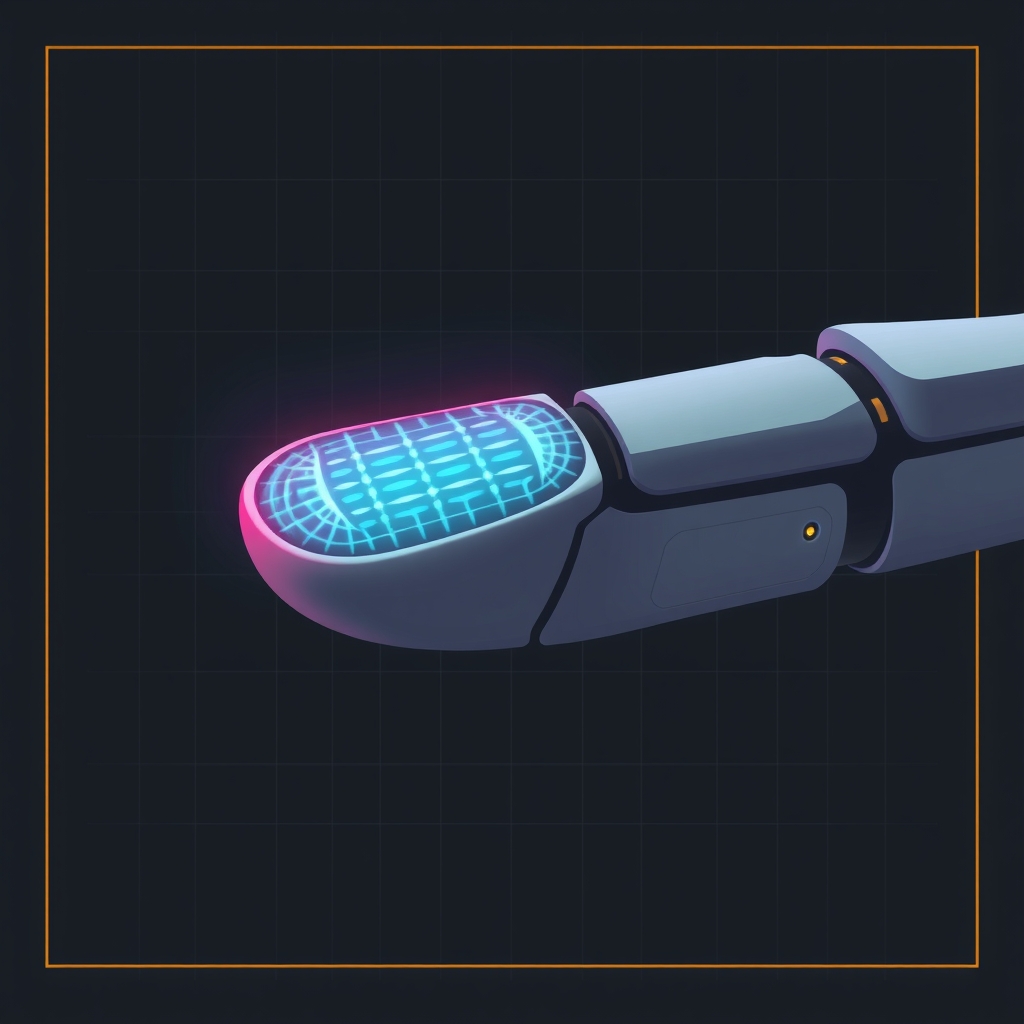
A consortium of European universities (Queen Mary University of London, University of Florence, University of Trieste, University of Trento) has demonstrated a robotic fingertip whose synthetic skin changes colour when deformed. By illuminating the skin and analysing the reflected hue, the sensor can produce real‑time maps of topology, strain and contact pressure with a spatial resolution of 100 µm. Demo videos show the fingertip distinguishing the raised lettering on a U.S. penny and the vein pattern of a leaf, illustrating a level of tactile detail that rivals many electronic arrays.
Comparing the two tactile strategies
| Feature | Loomia Smart Skin kit (capacitive + FSR) | Mechano‑chromic fingertip |
|---|---|---|
| Primary sensing principle | Electrical capacitance and resistance change | Optical colour shift in a mechano‑chromic polymer |
| Spatial resolution | Not disclosed (typical commercial kits) | 100 µm (sub‑millimetre) |
| Shear detection | Planned in R&Y joint module (sample Jan 2027) | Not reported |
| Form factor | Flexible mesh bonded to cloth/leather | Thin polymer film on a rigid fingertip |
| Target applications | Automotive smart surfaces, robot‑skin patches, gripper integration | High‑precision texture mapping, surgical tools, delicate handling |
What these developments mean for embodied AI
Loomia’s approach offers a comparatively inexpensive, mass‑manufacturable skin that can be wrapped around large robot surfaces and report absolute pressure or rapid force transients. The upcoming pressure‑plus‑shear module widens the signal set that a humanoid hand can use for grip‑force control. In parallel, the colour‑based fingertip shows that optical read‑out can achieve micron‑scale texture discrimination without dense electronics, opening possibilities for applications where visual and tactile feedback overlap (e.g., minimally invasive surgery or fine assembly).
Outlook for developers and investors
Both projects are transitioning from proof‑of‑concept to production‑ready hardware. The January 2027 engineering sample marks a concrete milestone for R&Y’s pressure‑shear sensor, while the colour‑sensing fingertip is already documented in a peer‑reviewed demonstration. Investors watching the tactile‑sensor niche should note that traditional material suppliers such as Unichem are now entering the electronic‑skin market, potentially accelerating volume‑manufacturing pipelines for both automotive and robotic customers.
Conclusion Tactile perception is moving out of the lab. Unichem’s acquisition of Loomia brings a flexible, low‑cost electronic skin into a supply chain that already serves global automakers, while R&Y’s joint sensor roadmap promises shear‑aware modules later this year. At the same time, a mechano‑chromic fingertip demonstrates that colour‑based read‑out can resolve surface features at the scale of human fingertips. For anyone building or funding humanoid robots, the convergence of these technologies means future platforms will be able to measure how hard they are holding an object and see its fine texture, unlocking new use‑cases in manufacturing, health care and service robotics.
Sources
This article was researched and fact-checked against the following sources:
- Unichem acquires Loomia to accelerate entry into the humanoid 'skin' market - The Robot Report (therobotreport.com)
- The Robot Report (therobotreport.com)
- Unichem Acquires US Electronic Skin Firm Loomia, Entering Humanoid Tactile Sensing Market — BigGo Finance (finance.biggo.com)
- Octopus robot gripper switches fast from rigid to supple (newatlas.com)
- Mechanochromic Skin Gives Robot Finger Fine Senses - IEEE Spectrum (spectrum.ieee.org)