Key takeaways
- Lattice says each of its major FPGA families includes root-of-trust components with on-chip non-volatile memory and two lockable flash images.
- The security functions described by Lattice include device attestation, authenticated-code checks and data encryption.
- Most main processors and AI engines depend on instructions stored outside the chip; Lattice describes that retrieval process as vulnerable to attack.
- The sources contrast traditional robots in separated cells with humanoids operating in open, changing spaces around people.
- Humanoid data links span from 1 to 10 Mb at the edge and 2 to 10 Gb in higher-speed backbones, according to Electronic Design.
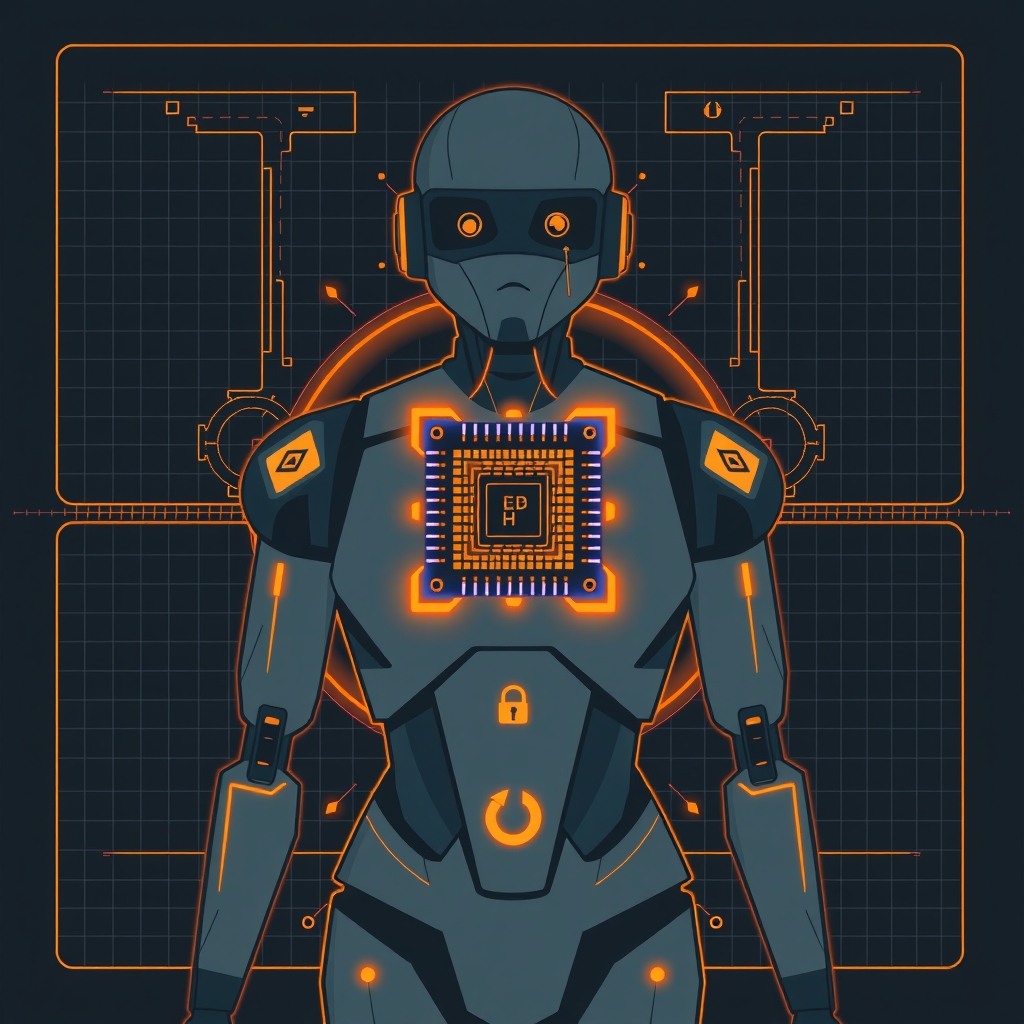
Lattice Semiconductor says its major FPGA families include root-of-trust components built around on-chip non-volatile memory. The devices can start from either of two flash images, and their configurations can be locked after manufacturing.
That is a specific hardware-security proposition for humanoid developers: protect the code and data around a robot's processors. It is not evidence that an FPGA, by itself, makes an entire robot safe.
Why humanoid robot security reaches the physical world
Traditional industrial robots were designed for predictable work inside structured cells, with preprogrammed routines and separation measures such as cages and light curtains. Humanoids are intended to work in open, changing environments, navigate around people and react to unexpected events.
A Lattice security executive frames the requirement plainly: a humanoid must be both safe and secure to be trustworthy. The distinction matters because safety limits depend on the integrity of the code and data used to enforce them. The sourced argument is about protecting that foundation, not promising end-to-end robot safety.
How Lattice's FPGA root of trust works
Lattice calls these components its root-of-trust, or ROT, products. The company says the design places non-volatile memory on the chip and supports two separate flash images that can be locked.
Once a chip has left the factory, its configuration can be locked down.
The supplied sources describe three relevant functions:
- Attestation: a device can answer whether it is authorized.
- Authenticated-code checks: digital signatures can be used to test whether the intended code is running.
- Encryption: data can be encrypted on the device.
These controls address identity, software integrity and data protection. They do not replace mechanical safeguards, functional-safety engineering or system-level validation.
Why external firmware storage matters
Lattice's representative says most main processors and AI engines do not contain internal flash. They retrieve instructions from external non-volatile storage or, in some designs, through a system download from the cloud. He describes that retrieval process as especially exposed to attack.
That makes external code retrieval the boundary Lattice is addressing with its root-of-trust products. The supplied sources do not provide comparative benchmarks against competing security designs.
Deterministic links still matter
Security is only one part of a humanoid's electronics stack. Electronic Design describes robot networks that connect sensors, compute nodes and actuators through links ranging from 1 to 10 Mb at the edge and 2 to 10 Gb in faster backbones.
Those figures show the range of connections a humanoid security design may need to accommodate. They do not establish that Lattice's root of trust supplies the robot's full networking or control architecture.
What buyers should take from the claim
The strongest supported case for Lattice is concrete: its FPGA families can combine lockable on-chip memory with attestation, authenticated-code checks and encryption. Together, those controls cover device authorization, intended code and data protection.
The open question is broader assurance. The sources do not establish end-to-end safety certification, quantify attack reduction or compare Lattice's approach with alternatives. Buyers should treat the FPGA root of trust as one hardware layer in a larger safety-and-security design.
Conclusion
Lattice's root-of-trust pitch rests on two lockable flash images, on-chip non-volatile memory and hardware-supported identity, code and data checks. For humanoid robots operating around people, that is a defensible security building block—not a claim that one chip secures the whole machine.
Sources
This article was researched and fact-checked against the following sources:
- How FPGAs become the gatekeepers of physical AI security (therobotreport.com)
- Eric Sivertson discusses FPGAs and robot security - The Robot Report (therobotreport.com)
- How 3D sensing and FPGAs are enabling humanoid robots: An interview with Karl Wachswender of Lattice Semiconductor — RoboticsBiz (roboticsbiz.com)
- Lattice Semiconductor - Wikipedia (en.wikipedia.org)
- Engineering Trust Through Physical Intelligence in Humanoids | Electronic Design (electronicdesign.com)