
Key takeaways
- The Mission Robotic Vehicle (MRV) lifted off on 21 July 2026 on a SpaceX Falcon 9 together with three Mission Extension Pods (MEPs).
- The spacecraft carries two seven‑jointed robotic arms built for on‑orbit manipulation.
- Each MEP is sized to give a compatible satellite at least six additional years of operational life.
- Earlier Mission Extension Vehicles (MEV‑1 and MEV‑2) have already added a combined ten years to three GEO customers.
- A 2027 demonstration plans for the MRV to attach an MEP to the Optus communications satellite in geosynchronous orbit.
Mission overview
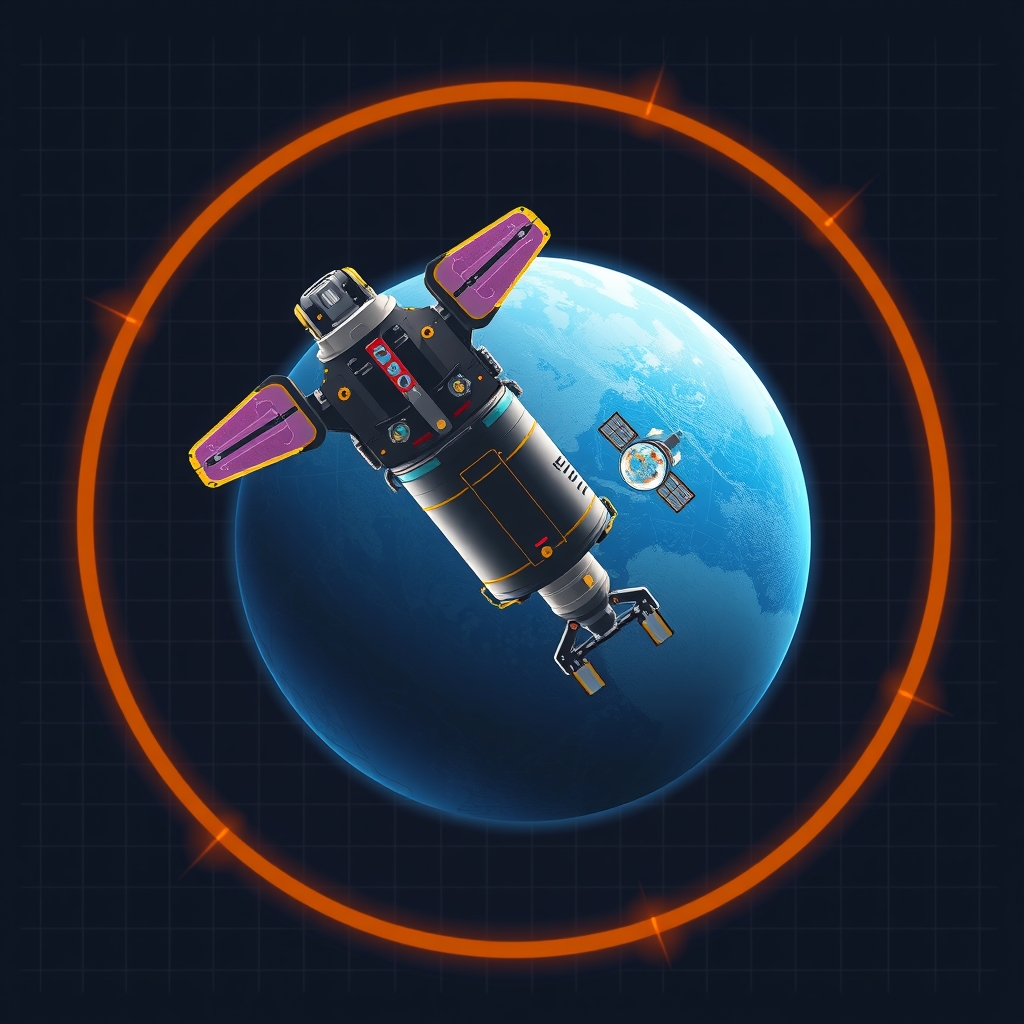
On 21 July 2026 a Falcon 9 launch placed Northrop Grumman’s Mission Robotic Vehicle on a trajectory toward the geosynchronous belt. The same launch also delivered three modular propulsion units—Mission Extension Pods—that the MRV can later affix to customer satellites. The stack is intended to operate at roughly 27,000 miles above Earth, where it will conduct a series of servicing demonstrations.
Servicing hardware: arms and pods
The MRV’s manipulation suite consists of two articulated arms, each featuring seven joints. The design lets the vehicle reach around a target spacecraft, grip hardware, and install—or remove—components without crew intervention. Alongside the arms, the vehicle carries three self‑contained propulsion modules (MEPs). According to program documents, each pod can provide six or more extra years of station‑keeping for a compatible satellite, extending its revenue‑generating window.
| Feature | Mission Robotic Vehicle (MRV) | Mission Extension Vehicle‑1 (MEV‑1) |
|---|---|---|
| Launch vehicle | SpaceX Falcon 9 (21 Jul 2026) | Falcon 9 (2019) |
| Destination altitude | ~27,000 mi (GEO) | GEO |
| Robotic arms | 2 × seven‑joint arms (DARPA‑derived) | none |
| Propulsion modules carried | 3 MEPs (modular) | 1 MEV (propulsion‑only) |
| Life‑extension per module | ≥ 6 years | 6 years added to Optus satellite |
| Cumulative life‑extension delivered (to date) | – | 10 years across three customers |
The table draws exclusively from public statements and launch records.
Heritage services: MEV‑1 and MEV‑2
Northrop Grumman’s first generation of on‑orbit servicing hardware, the Mission Extension Vehicle series, has already demonstrated the business case for life extension. MEV‑1 recently detached from an Australian Optus communications satellite after more than a year of attached operation, freeing the host for its next assignment. The two MEVs that were launched in 2019 and 2020 together have contributed a total of ten extra years of service to three operators—including two Intelsat platforms and the Optus satellite. MEV‑2 remains attached to an Intelsat satellite with a contractually defined end date in 2030.
Planned 2027 on‑orbit repair demo
The next milestone for the MRV is slated for 2027. The vehicle will travel to the Optus GEO satellite, employ its dual arms to grasp the spacecraft, and bolt one of the three MEPs onto the structure. If successful, the operation will move beyond the docking‑only approach used by the earlier MEVs and showcase true hands‑on servicing, including the possibility of adding propulsion, swapping out components, or adjusting orbital slot.
Business model shift
A notable change with the MRV architecture is the separation of ownership between the servicing platform and the propulsion pods. Satellite operators purchase the Mission Extension Pods outright and attach them to their assets, while the MRV itself remains a reusable service vehicle that can be redeployed to multiple customers. This modular approach is intended to lower per‑mission costs and increase the number of satellites that a single servicer can visit.
Technical challenges and outlook
Operating at GEO requires precise autonomous navigation; Northrop Grumman notes that the relative motion between servicer and target can be significant, demanding high‑accuracy guidance. Northrop’s logistics director, Cassie Wong, describes the effort as “a pattern shift where we can see space as sustainable, with a more resilient architecture and infrastructure base where we can do things like spacecraft repairs, life extension, or even upgrades and maintenance of satellites.” The MRV is also built with on‑orbit refuelling capability, a feature that could become standard for future commercial spacecraft if the demonstration proves reliable.
Conclusion
The July 2026 launch delivered a robotic platform equipped with dual seven‑jointed arms and three modular propulsion pods, all aimed at extending the usable life of geosynchronous satellites. If the 2027 attachment of an MEP to the Optus satellite succeeds, it will provide data that could inform how reusable on‑orbit servicers might be incorporated into future satellite operations.
Sources
This article was researched and fact-checked against the following sources:
- Northrop Grumman's Mission Robotic Vehicle Becomes a Robot Satellite Mechanic for Longer-Lasting Satellites (itechpost.com)
- Northrop Grumman's robotic space mechanic undocks from satellite, preps for next-gen servicing (stockpil.com)
- FCC Covered List Bans New Foreign Mobile Robots in US - IEEE Spectrum (spectrum.ieee.org)
- Videos: A Lunar Mars Rover, Floating Robots, and More - IEEE Spectrum (spectrum.ieee.org)
- Motion capture exoskeletons enhance violin teaching (newatlas.com)