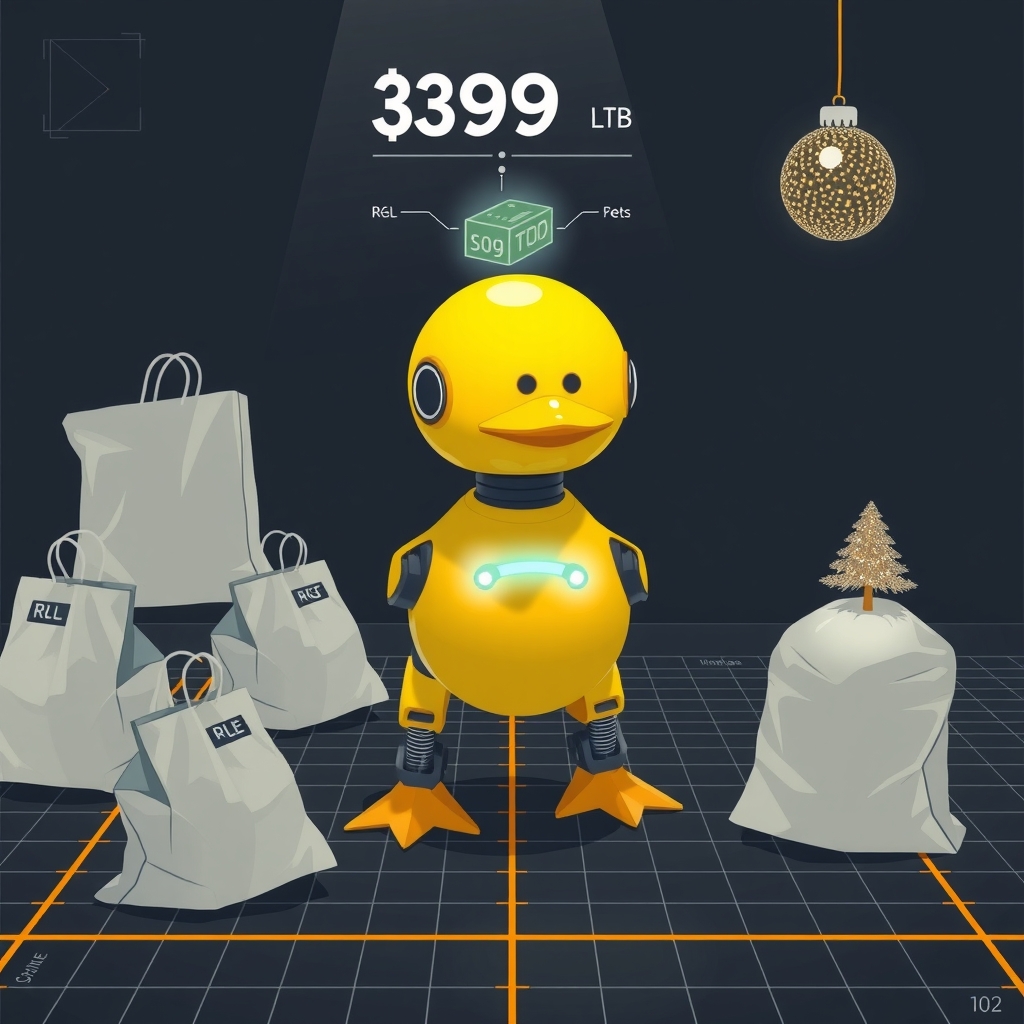
On August 27 2026 Hugging Face and its robotics unit Pollen Robotics opened pre‑orders for the Microduck, a biped robot priced at US $399 before taxes and shipping. The device is marketed as a hands‑on platform for developers who want to experiment with reinforcement‑learning‑driven motion.
Key takeaways
- Pre‑orders began on August 27 2026 at $399 before taxes and shipping.
- Height 25 cm, weight ≈800 g.
- 15 motors drive the legs, head and neck.
- Seven built‑in policies: walk, sit, stand, kick, grab, roller‑skate and self‑right after a fall.
- Sensor suite includes a wide‑angle camera, 8×8 time‑of‑flight LiDAR, two IMUs, microphones, a speaker, NFC, Wi‑Fi and Bluetooth.
- Onboard compute: Rockchip RK3566 AI‑accelerated CPU, 1 GB RAM, 32 GB flash, policy loop at 50 Hz.
- Removable NP‑F550 2600 mAh battery gives roughly one hour of operation.
- All software – SDK, MuJoCo‑based simulator and reinforcement‑learning pipeline – is released under the Apache 2.0 licence on GitHub.
- First shipments are scheduled for before Christmas 2026; later orders carry a 4‑to‑6 month lead time.
- Four colourways are offered: Cream, Graphite, Lavender and Sky.
- Hugging Face acquired Pollen Robotics in April 2025, extending its open‑source robotics effort.
- Research‑grade biped platforms typically start around $13 000, making Microduck an order‑of‑magnitude cheaper entry point.
What the hardware looks like
Microduck is a hand‑held biped that fits in one palm. Its 25 cm height and under‑800 g mass keep the kinetic energy of a fall low, and the robot can stand up on its own after tipping over. The articulated beak functions as a small gripper, letting the duck pick up lightweight items.
| Component | Specification |
|---|---|
| Motors | 15 degrees of freedom across legs, head and neck |
| Vision | Front wide‑angle camera |
| Depth | 8×8 time‑of‑flight LiDAR matrix |
| Motion sensing | Two IMUs (body and head) |
| Audio | Microphones and speaker; a per‑robot generated voice |
| Wireless | Wi‑Fi, Bluetooth, two NFC antennas |
| Compute | Rockchip RK3566 with AI accelerator |
| Memory / storage | 1 GB RAM, 32 GB flash |
| Policy loop | 50 Hz |
| Battery | Removable NP‑F550, 2600 mAh (~1 h runtime) |
| Pre‑installed behaviours | 7 |
All numbers are taken from the manufacturer’s spec sheet.
Open‑source software stack
The launch package publishes the full development kit on GitHub. The SDK, a MuJoCo‑based physics simulator, and the reinforcement‑learning training pipeline are all available under an Apache 2.0 licence, meaning developers can inspect, modify or extend any part of the stack.
How a new skill is created
The workflow that the team describes consists of four stages:
- Simulate the target motion in MuJoCo.
- Train a reinforcement‑learning policy against the simulated physics.
- Deploy the resulting policy to the physical duck via the SDK.
- Iterate by refining the simulation, retraining and redeploying. Because the robot is lightweight and its battery lasts only about an hour, a failed trial usually ends with the duck on the floor, after which it can stand up automatically – a design choice that keeps the risk of damage low during extensive trial‑and‑error cycles.
Pricing, availability and accessories
Pre‑orders are priced at $399 before taxes and shipping. Each unit ships with a dedicated game controller for immediate interaction. The initial batch is slated to arrive before Christmas 2026; orders placed after the launch window are listed with a 4‑to‑6 month lead time. Buyers can select from Cream, Graphite, Lavender or Sky finishes.
Position in the robotics ecosystem
At $399, Microduck is far less expensive than typical research‑grade biped platforms that start around $13 000. Those larger systems are aimed at laboratory research, while Microduck brings the same embodied‑learning pipeline to a tabletop form factor, opening up reinforcement‑learning‑driven motion experimentation to hobbyists, students and small teams.
Outlook
The release follows Hugging Face’s April 2025 acquisition of Pollen Robotics, a move the company framed as a way to make robotics “open, affordable, and private.” CEO Clément Delangue described the robot as “a tiny $399 open‑source robot you can teach new tricks with reinforcement learning.” The open‑source nature of both hardware and software positions Microduck as a low‑cost entry point for anyone looking to explore physical AI.
Sources
This article was researched and fact-checked against the following sources:
- Hugging Face Launches $399 Open-Source Microduck Robot for Reinforcement Learning (tao.media)
- Microduck: Hugging Face's $399 open-source robot duck, explained | eesel AI (eesel.ai)
- Hugging Face Unveils Microduck: A $399 Open-Source 25 cm Biped You Train with Reinforcement Learning - MarkTechPost (marktechpost.com)
- (VIDEO) Hugging Face Unveils Microduck, a $399 Open-Source Robot Duck You Can Teach New Tricks Right at Home (ibtimes.com.au)
- Hugging Face Launches $399 Open-Source Microduck Robot Ahead of Christmas - RobotToday (robottoday.com)