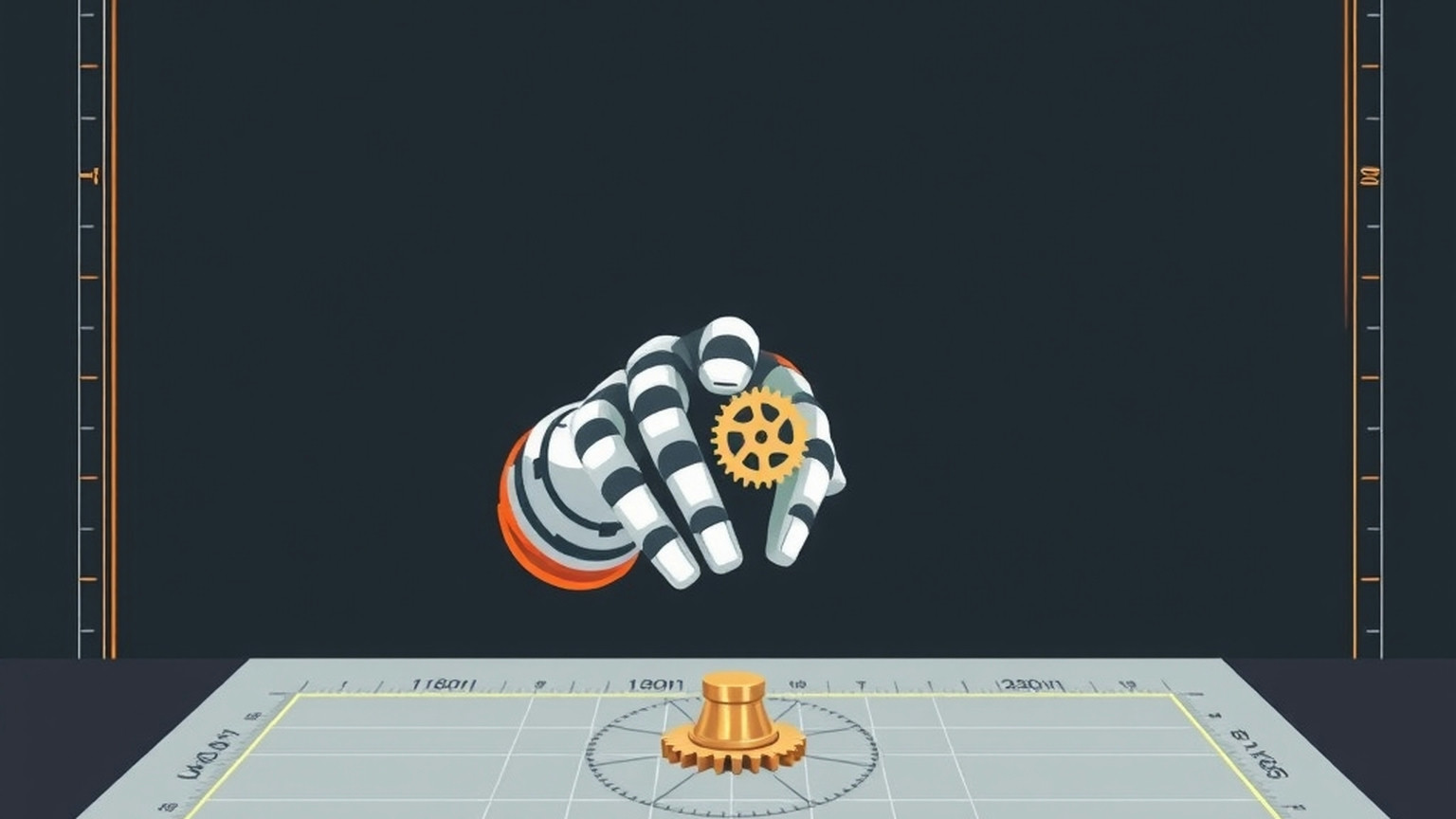
AnySkin separates its flexible magnetic sensing surface from the electronics behind it. The paper's authors present that separation as a way to replace a worn skin without rebuilding the sensing board. Under the surface, five magnetometers each measure magnetic flux along three axes.
Fabrication recipe
The official project page specifies a 1:1:2 mixture of Smooth-On Dragon Skin 10 Slow and MQFP-15-7 magnetic particles with a 25-micrometre particle size. Builders cure the mixture in two-part molds, then magnetize the finished skins with a pulse magnetizer.
The same page explains the sensing principle: contact changes the magnetic field created by particles inside the flexible surface. The magnetometers record those changes while the skin remains physically separate from the circuit board.
Startup-kit installation
The repository's quick-start guide assumes the AnySkin startup kit. It tells users to connect the magnetometer board to an Adafruit QT Py with the supplied QWIIC cable, slide the board into the 3D-printed fingertip and pull the skin over the tip. The QT Py then connects to a computer over USB-C.
For software access, the repository lists version 1.0.0 as its stable release and installs with pip install anyskin. AnySkinBase collects data while blocking the calling program; AnySkinProcess buffers data in a background process.
Replacement and slip benchmarks
The paper reports a replacement study with 10 non-expert users. AnySkin took 12 ± 5 seconds on average. The comparison table reports 82 ± 64 seconds for adhesive-mounted ReSkin, 236 ± 64 seconds for screw-mounted ReSkin and 58 ± 22 seconds for DIGIT. The table marks AnySkin, screw-mounted ReSkin and DIGIT as reusable after replacement; adhesive-mounted ReSkin is marked non-reusable.
The slip experiment used a Kinova Jaco arm, an OnRobot RG-2 gripper and 40 everyday objects: 30 for training and 10 for evaluation. The authors report that their LSTM detected slip on unseen objects with 92% accuracy using tactile signals alone.
A separate plug-insertion experiment tested whether a policy trained with one skin would transfer to a replacement. The paper reports a 13% performance drop for AnySkin and a 43% drop for ReSkin on that task.
Documented limitation
The authors note that AnySkin inherits interference from magnetic and ferromagnetic objects in its environment. They identify magnetic-sensor noise reduction and changes to the skin design as possible subjects for future work.
Sources
This article was researched and fact-checked against the following sources:
- [2409.08276] AnySkin: Plug-and-play Skin Sensing for Robotic Touch (arxiv.org)
- AnySkin: Plug-and-play Skin Sensing for Robotic Touch (any-skin.github.io)
- GitHub - raunaqbhirangi/anyskin: Interfacing Repository for the AnySkin tactile sensor · GitHub (github.com)
- AnySkin: Plug-and-play Skin Sensing for Robotic Touch (arxiv.org)